
Typhoid Vaccine Broadstairs: Do You Need It for Travel?
If you’re travelling to India, Pakistan, Bangladesh or another country where typhoid is a risk, you may be advised to have a typhoid vaccination before you go.
702
typhoid & paratyphoid cases in 2024
+8%
on 2023 (645 cases)
287
travel cases, Jan–Jun 2026
But not every traveller needs it. Whether vaccination is recommended depends on your destination, where you’ll be staying, how long you’ll be away, what you’ll be doing and your individual health.
Typhoid remains an important infection in UK travellers. The UK Health Security Agency (UKHSA) recorded 702 cases of typhoid and paratyphoid fever in England, Wales and Northern Ireland during 2024, an 8% increase on 2023 and, at the time, the highest annual total recorded. In the first six months of 2026 alone, a further 287 travel-associated cases of enteric fever were reported.
Typhoid vaccination at Pierremont Pharmacy: £45
If you live in Broadstairs, Ramsgate, Margate or elsewhere in Thanet or East Kent, Pierremont Pharmacy Travel Clinic can assess your itinerary and advise whether typhoid vaccination is appropriate.
What is typhoid?
Typhoid fever is a potentially serious bacterial infection caused by Salmonella Typhi. It is usually acquired by eating food or drinking water contaminated with the faeces of an infected person or carrier. This means typhoid is particularly associated with places where access to safe drinking water, sanitation and reliable food hygiene is limited. So it isn’t simply a form of traveller’s diarrhoea: once Salmonella Typhi has been swallowed, the bacteria can spread beyond the gut and cause a systemic illness affecting the whole body.
Typical symptoms include:
- Persistent fever
- Headache
- Abdominal pain
- Fatigue
- Muscle or joint pains
- Constipation or diarrhoea
- Nausea
- Reduced appetite
- Sometimes a rash
Serious complications can include intestinal bleeding and perforation of the bowel. Antibiotics can treat typhoid, but antibiotic-resistant strains are becoming increasingly common.
Key Point
Typhoid is a systemic bacterial infection, not simply an upset stomach. Severe cases can require hospital treatment, and increasing antibiotic resistance can make infection harder to treat.
Typhoid is a systemic bacterial infection, not simply an upset stomach. Severe cases can require hospital treatment, and increasing antibiotic resistance can make infection harder to treat.
Typhoid and paratyphoid: what's the difference?
You’ll often see typhoid and paratyphoid grouped together under the term enteric fever. Typhoid is caused by Salmonella Typhi, whereas paratyphoid is caused by Salmonella Paratyphi A, B or C.
The illnesses can look very similar, but there is an important difference for travellers: current UK typhoid vaccines protect against typhoid but should not be relied upon to protect against paratyphoid. That means food and water precautions remain important even after vaccination.
Where is typhoid most common?
The largest global burden of typhoid occurs in Asia, but disease also occurs in parts of:
- Africa
- Central America
- South America
- Other regions where sanitation and access to clean water are limited
For UK travellers, India, Pakistan and Bangladesh are particularly important. The NHS states that most people diagnosed with typhoid in the UK have recently travelled to one of these three countries. Most UK travel-related infections occur in travellers visiting friends and relatives in the Indian subcontinent.
However, the country alone doesn’t determine whether you need vaccination. Your risk also depends on:
- Where within the country you are going
- How long you'll be staying
- Whether you're visiting friends and relatives
- Type of accommodation
- Where you'll be eating
- Access to safe water
- Your planned activities
UK cases are still substantial
UKHSA recorded 702 cases of typhoid and paratyphoid fever during 2024 in England, Wales and Northern Ireland, an 8% rise from 645 cases in 2023. The 2024 figure was the highest annual total recorded at that point. More recently, UKHSA reported 287 travel-associated enteric fever cases between January and June 2026. These figures combine typhoid and paratyphoid, so they should not be interpreted as 702 or 287 cases of typhoid alone. They nevertheless demonstrate that enteric fever remains a significant infection among people travelling internationally from the UK.
Travel-health point
Most typhoid and paratyphoid diagnosed in the UK is acquired overseas. South Asia, particularly India, Pakistan and Bangladesh, is especially important for UK travellers.
Visiting friends and relatives deserves particular attention
People travelling to visit friends and relatives can have a higher exposure to enteric infections than conventional tourists. There are several possible reasons: trips may be longer, travellers may eat more frequently in family homes or local settings rather than tourist hotels, and they may spend time outside the areas commonly visited by package tourists. There can also be a natural sense of familiarity with a country previously lived in or visited frequently. But familiarity doesn’t equal immunity, not least because someone who grew up in a country where typhoid occurs may still be susceptible years later.
Who should consider typhoid vaccination?
We recommend vaccination for travellers whose planned activities put them at increased risk of typhoid in areas where sanitation and food hygiene may be poor. That may include people who are:
- Travelling to a country where typhoid is common
- Staying for prolonged periods
- Visiting friends or relatives
- Travelling frequently
- Staying in locations where sanitation is limited
- Likely to eat or drink where food and water hygiene cannot be assured
Recommendations vary by destination. The most appropriate approach is therefore to check the current advice for the exact country you are visiting and combine this with an individual travel-risk assessment. If you live in Broadstairs, Ramsgate, Margate or elsewhere in Thanet, Pierremont Pharmacy’s travel-health service can assess these factors with you.
For example, 17 cases associated with India doesn’t mean India was necessarily more dangerous per traveller than a country with six cases. The figures do show, however, that chikungunya is a genuine and increasing infection among returning UK travellers.
Not sure if typhoid vaccination is right for your trip?
What typhoid vaccines are available in the UK?
Two principal typhoid vaccine options are currently available for UK travellers.
| Vaccine | Type | Schedule | Licensed age | Timing before travel |
|---|---|---|---|---|
| Typhim Vi | Injectable Vi polysaccharide vaccine | One injection | 2 years+ | Ideally at least 2 weeks before exposure |
| Vivotif | Live oral vaccine | 3 capsules on days 1, 3 and 5 | 5 years+ | Course completed at least 1 week before travel |
Older combined hepatitis A/typhoid products including ViATIM and Hepatyrix have been discontinued in the UK. (Single-antigen hepatitis A and typhoid vaccines can instead be given separately where both are required.)
Typhim Vi: the injectable typhoid vaccine
Typhim Vi is an injectable vaccine containing purified Vi capsular polysaccharide from Salmonella Typhi. For adults and children aged 2 years and over, the primary schedule is straightforward: one 0.5 ml injection. The vaccine should ideally be given at least two weeks before potential exposure, and immunity generally develops within approximately 1–3 weeks. If exposure risk continues, revaccination is recommended at three-year intervals.
How effective is Typhim Vi?
Unlike some newer vaccines where effectiveness is inferred predominantly from antibody responses, Typhim Vi has direct clinical-efficacy data. In a randomised controlled trial in Nepal involving 3,457 participants, one dose provided approximately 74% protection against blood-culture-confirmed typhoid during 20 months of surveillance. Another study in South African children found approximately 55% protection over three years. That illustrates an important point:
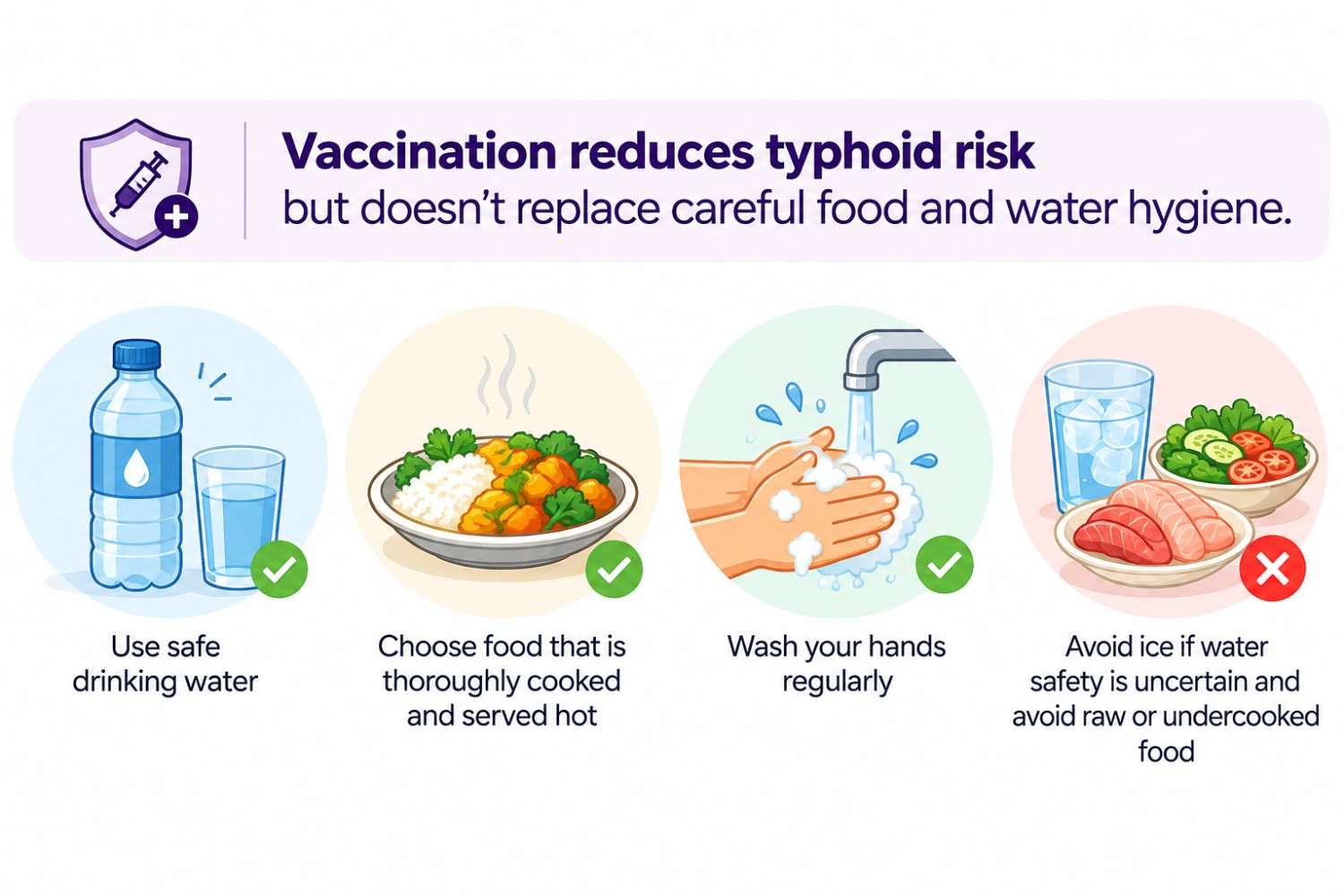
Typhoid vaccination reduces risk, but it doesn’t eliminate it. A vaccine effectiveness figure of around 74% means food and water hygiene still matters.
What is Vivotif?
Vivotif is a live attenuated oral typhoid vaccine. Instead of having an injection, the traveller takes one capsule on day 1, one on day 3 and one on day 5. Note that all three doses are necessary to complete the primary course. The capsules should be swallowed whole with cold or lukewarm water, on an empty stomach, at least one hour before the next meal. The course should be completed at least one week before entering a typhoid-risk area. Protection begins approximately 7–10 days after the final capsule, and Vivotif is licensed for adults and children aged 5 years and over.
How effective is Vivotif?
Clinical field studies provide direct evidence of protection. The current UK product information reports approximately 71% protective efficacy during the first year after vaccination and approximately 67% over three years for the three-dose regimen. Again, that isn’t complete protection, and so food and water precautions remain necessary.
Injectable or oral typhoid vaccine: which is better?
There isn’t one universally superior option.
| Consideration | Typhim Vi | Vivotif |
|---|---|---|
| Administration | Injection | Capsules |
| Number of doses | 1 | 3 |
| Live vaccine | No | Yes |
| Minimum licensed age | 2 years | 5 years |
| Suitable for significant immunosuppression | May be considered following assessment | Generally unsuitable |
| Antibiotic interaction | No equivalent live-vaccine issue | Antibiotics can interfere |
| Timing | Ideally ≥2 weeks before exposure | Finish ≥1 week before travel |
| Repeat vaccination if risk continues | Around every 3 years | Around every 3 years |
The injectable vaccine is simpler and does not contain live organisms. The oral vaccine avoids an injection, but because it contains a live attenuated strain, it isn’t appropriate for everybody and requires more careful coordination with other medicines. We can advise which option is appropriate after reviewing your age, health, medicines and itinerary.
Antibiotics can interfere with Vivotif
This is an important practical consideration. Vivotif works by allowing the live attenuated vaccine organisms to stimulate an immune response within the gut, and antibiotics can interfere with this process. The UK product information therefore recommends avoiding antibiotic or antibacterial sulphonamide treatment for at least three days before and after Vivotif, with longer intervals potentially required for long-acting antibiotics. Timing may also need to be considered if you require malaria prophylaxis.
This is one reason a good travel-health consultation considers your whole travel-health plan, rather than dealing with each vaccine or medicine separately.
Antibiotic-resistant typhoid
Typhoid remains treatable with appropriate antibiotics, but antibiotic resistance is an increasing problem. UKHSA specifically highlights the emergence of antibiotic-resistant typhoid associated with Pakistan, which can limit the effectiveness of commonly used treatments. Extensively drug-resistant (XDR) strains have been recognised internationally, which makes drug resistance a growing concern. This isn’t to say that treatment is impossible, but it reinforces the importance of prevention through vaccination where appropriate, food and water precautions, and early medical assessment if symptoms develop.
Important: The choice between injectable and oral typhoid vaccination depends on factors such as age, medical history, immune status, other medicines and how soon you are travelling. A pharmacist can help you decide which option is most appropriate.
Food and water precautions still matter
No currently available typhoid vaccine provides complete protection, and vaccination does not reliably protect against paratyphoid. Even after vaccination:
- Wash your hands carefully, especially before eating and after using the toilet
- Use safe drinking water
- Avoid ice if water safety is uncertain
- Choose food that has been thoroughly cooked and served hot
- Avoid raw or undercooked meat and seafood
- Peel fruit yourself where appropriate
- Avoid unpasteurised dairy products
- Take care with salads and uncooked foods where hygiene is uncertain
The NHS advises travellers in typhoid-risk areas to use bottled or appropriately treated water and to be cautious with food that may have been washed or prepared using unsafe water.
The simple rule: Typhoid protection is not vaccination instead of food and water precautions. It is vaccination, where indicated, plus careful food and water hygiene.
NHS versus private vaccination
Can I get typhoid vaccination free on the NHS?
Yes, potentially. Typhoid is one of the travel vaccines that can be provided free on the NHS following an appropriate travel-risk assessment at a GP surgery. The NHS currently lists four travel vaccinations that may be available free: cholera, polio, hepatitis A and typhoid.
Not every GP practice provides a full travel-health service, and access and appointment availability vary. Private travel clinics and pharmacies can also provide typhoid vaccination, and we think it’s important that travellers know both options.
Why use a private travel clinic?
- Destination-specific vaccines
- Malaria prevention
- Food and water risks
- Mosquito-borne diseases
- Animal-bite risks
- Current medicines
- Underlying health conditions
- How soon you are departing
For people travelling to complex destinations or requiring several interventions, looking at the entire itinerary together can be particularly useful.
How much does typhoid vaccination cost at Pierremont Pharmacy?
Pierremont Pharmacy Travel Clinic, Broadstairs
How far in advance should I have a typhoid vaccine?
The NHS recommends seeking travel-health advice approximately 4–6 weeks before travel where possible.
For Typhim Vi, vaccination should ideally occur at least two weeks before potential exposure, and for Vivotif, all three capsules should be completed at least one week before travel to the risk area. However, if you are travelling sooner, don’t assume it is too late: seek travel-health advice anyway. Depending on your circumstances, useful vaccination and preventive measures may still be possible.
Frequently asked questions
Typhoid vaccination is commonly considered for travellers to India, but the recommendation depends on your itinerary, duration of travel, accommodation and activities. India is one of the destinations most commonly associated with typhoid and paratyphoid in returning UK travellers.
Many travellers to Pakistan will be advised to consider typhoid vaccination, particularly those visiting friends and relatives or spending extended periods there. Pakistan has also been an important source of antibiotic-resistant typhoid.
Typhoid risk is significant in Bangladesh and it is one of the countries frequently associated with enteric fever in returning UK travellers. Your individual vaccination recommendation should still be based on your exact itinerary and current advice.
For Typhim Vi, the primary vaccination consists of one injection. If you remain at risk, revaccination is generally recommended at three-year intervals.
Both current injectable and oral approaches generally require reinforcing vaccination after around three years if exposure risk continues.
Typhim Vi is licensed from age 2 years and Vivotif from age 5 years. UK guidance also allows injectable vaccination in some children aged 12 months to under 2 years following an individual high-risk assessment, although this is outside the standard licensed age range.
This requires individual assessment. The available evidence in pregnancy is limited, so vaccination should be considered according to the likely infection risk and the characteristics of the particular vaccine.
No reliable protection against paratyphoid should be assumed. Good food, water and hand hygiene therefore remains important even after typhoid vaccination.
Yes. Neither vaccine provides complete protection. Vaccination reduces risk but should always be combined with sensible food and water precautions.
Antibiotics can interfere with the live organisms in Vivotif. Recent or planned antibiotic treatment therefore needs to be considered when timing the vaccine.
Typhoid is one of the travel vaccinations that may be provided free through an NHS GP surgery after an appropriate travel-risk assessment. Private vaccination is also available through pharmacies and travel clinics.
Still seek advice. Although several weeks of planning is ideal, it may not be too late to vaccinate or address other important travel-health risks.
Should you have a typhoid vaccine?
For some travellers, vaccination is clearly worthwhile, while for others, the risk may be low enough that vaccination is not routinely recommended.
The right decision depends on more than the country you are visiting. We consider:
- Where you are travelling
- How long you will be there
- Whether you are visiting friends or relatives
- Where you will be eating and staying
- What other vaccines you may need
- Your medical history
This individual assessment is more useful than simply working through a list of travel vaccines.
Book a travel-health consultation in Broadstairs
If you're planning overseas travel, Pierremont Pharmacy can review your itinerary, vaccination history, medical history and medicines and advise whether typhoid vaccination is appropriate for your trip, along with other travel-health precautions.
We serve Broadstairs, Ramsgate, Margate, Thanet and surrounding East Kent.
Sources
- UK Health Security Agency. Laboratory-confirmed typhoid and paratyphoid cases: statistics.
- UK Health Security Agency. Travellers reminded to take precautions to avoid infections abroad this summer, July 2026.
- TravelHealthPro / NaTHNaC. Typhoid fever.
- NHS. Travel vaccinations.
- NHS. Typhoid fever.
- Typhim Vi. UK Summary of Product Characteristics.
- Vivotif. UK Summary of Product Characteristics.
Written by: Graham Philips, BPharm, Dipp Comm Pharm, FRCPharm. GPhC Registered Pharmacist
Clinically reviewed by: Graham Phillips Dipp Comm Pharm, FRCPharm
GPhC number: 2027398
Last clinically reviewed: September 2026
Travel-health recommendations, vaccine availability and disease epidemiology can change. This article provides general information and does not replace an individual travel-health assessment.